Help

PICO◊ sNPWT Transforming Pathways
Simplify negative pressure wound therapy...
it's possible
Complete the patient pathway by identifying the risk factors
About

Welcome!
How it works
PICO◊ sNPWT Transforming Pathways: How it works
Swipe for more
Is your patient at risk of surgical site complications (SSCs)?*
Create a tailored SSC prevention pathway for your surgical procedures
Swipe for more
*The risk factors are based on the WUWHS consensus definition of risk factors. The generated pathways are based on published recommendations and are not provided by Smith&Nephew 10
Please select 1 option
Please select at least 1 option
Please select at least 1 option
Step Four
Your surgical site complication (SSC) prevention pathway
Help prevent surgical site complications with PICO◊ sNPWT as an alternative to standard surgical dressings.
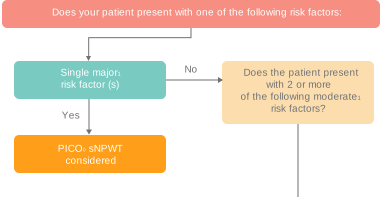
Major risk factor:
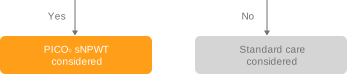
Thank you!
Help to significantly reduce surgical site complications with PICO◊ sNPWT*
*Compared to care with standard dressings; p'<'0.05. T2-8
References: 1. Sugrue M, Ciprandi G, Djohan R, et al. World Union of Wound Healing Societies (WUWHS) Consensus Document. Closed surgical incision management: Understanding the role of NPWT. Wounds Int [Internet]. 2016. https://www.woundsinternational.com/resources/details/closed-surgical-incision-managementunderstandingthe- role-of-npwt. 2. Global guidelines for the prevention of surgical site infection, 2nd ed. [online] Available from: https://www.who.int/publications/i/item/global-guidelinesfor- the-prevention-of-surgical-site-infection-2nd-ed Last accessed September 2022.
Please select a white tile
Or
Complete the pathway by categorising risk factors, and using PICO◊ sNPWT if appropriate
Timer
The patient
You Selected
Is this correct?
According to NICE guidance, the use of PICO may be too premature.
Confirm Selection
XXXX
Confirm Selection
XXXX
Restart Game
You answered all risks incorrectly, Please restart the game.
Enter your initials
Thank you for participating
Thank you!
Your pathway has been sent to your email
References
1: Patient info | Possible with PICO. Smith&Nephew. Available from: https://www.possiblewithpico.com/patient-info Last accessed September 2023
2: Galiano RD, Hudson D, Shin J, et al. Incisional Negative Pressure Wound Therapy for Prevention of Wound Healing Complications Following Reduction Mammaplasty. Plast Reconstr Surg Glob Open. 2018;6(1):e1560
3: Pellino G, Sciaudone G, Candilio G, et al. Effects of a new pocket device for negative pressure wound therapy on surgical wounds of patients affected with Crohn’s disease: a pilot trial. Surg Innov. 2014;21(2):204-212.
4: Matsumoto T, Parekh SG. Use of Negative Pressure Wound Therapy on Closed Surgical Incision After Total Ankle Arthroplasty. Foot Ankle Int. 2015;36(7):787- 794
5: O’leary DP, Peirce C, Anglim B, et al. Prophylactic Negative Pressure Dressing Use in Closed Laparotomy Wounds Following Abdominal Operations: A Randomized, Controlled, Open-label Trial: The P.I.C.O. Trial. Ann Surg. 2017;265(6):1082-1086
6: Helito CP, Sobrado MF, Giglio PN, et al. The use of negative-pressure wound therapy after total knee arthroplasty is effective for reducing complications and the need for reintervention. BMC Musculoskeletal Disorders. 2020;21(490):1 - 8.
7: Witt-Majchrzak A, Żelazny P, Snarska J. Preliminary Outcome Of Treatment Of Postoperative Primarily Closed Sternotomy Wounds Treated Using Negative Pressure Wound Therapy. Przeglad Chirugiczny. 2014;86(10):456-465.
8: Adogwa O, Fatemi P, Perez E, et al. Negative pressure wound therapy reduces incidence of postoperative wound infection and dehiscence after long-segment thoracolumbar spinal fusion: a single institutional experience. The Spine Journal. 2014;14(12):2911 - 2917
9: Global guidelines for the prevention of surgical site infection, 2nd ed. [online] Available from: https://wwwwho.int/publications/l/item/global-guidelinesfor-the prevention of surgical-site-infection-2nd-ed Last accessed September 2022.
10: Sugrue M. Ciprandi G, Djohan R, et al. World Union of Wound Healing Societies (WUWHS) Consensus Document, Closed surgical incision management: Understanding the role of NPWT. Wounds int [internet]. 2016. https://wwwwoundsinternational.com/resources/details/closed-surgical-incision-managementunderstandingthe role-of-npwt.
11: PICO negative pressure wound dressings for closed surgical incision. Medical technologies guidance [MTG43]. National Institute for Health and Care Excellence (NICE), 2019. Available from: https://www.nice.org.uk/guidance/mtg43 Last accessed September 2023.
Sorry!
This app is not available on your device. Please try loading this app on a device with a bigger screen.